
The Source for Survivors
  • Home
  • About the Pathways Model
  • Find Your Pathway
    • Pathway for Survivors >
      • Blog - Pathway for Survivors
      • The Pathway for Survivors Mini-Journal
    • Pathway for Community Supports >
      • Blog - Pathway for Community Supports
  • Financial Abuse Recovery Book
  • Other Resources
  • About Christine Murray
  • Contact Form
  • Sign Up for Our E-Newsletter
Picture

Blog: Pathway for Survivors

Download Your Free Copy of the Pathway for Survivors Mini-Journal by Clicking here!

Using Social Media as a Tool that Supports (and Doesn’t Detract From) Your Healing as a Survivor of an Abusive Relationship

3/26/2024

0 Comments

 
Picture
By Christine Murray

Social media often gets a bad rap for its potential to create distress, leading us down the rabbit holes of comparison and mindless scrolling. For survivors of abusive relationships, navigating social media can sometimes feel like tiptoeing through a minefield of triggers and relational challenges. 

However, despite the potential pitfalls, social media is an integral part of many of our daily lives.  Because of this, it's crucial to consider how we can leverage it as a tool to support our healing journey while mitigating its harmful effects. Personally, I've found that by taking proactive steps to manage how I engage with social media, it has become a powerful tool for connection, information, and inspiration in my own healing journey - even though, admittedly, sometimes it does still create stress and challenges as well!

Here are some strategies that have worked for me, and I'd also love to hear your thoughts and ideas on how you think survivors can use social media to promote their healing.
  1. Take Control of Your Connections: I've learned to liberally use features like blocking, unfollowing, and muting to manage my social media connections with my safety as the priority. While it's not always easy or without potential repercussions, it's essential to feel empowered to make decisions that are best for you in terms of who you're connected with and how much influence they have on your well-being.

  2. Let Algorithms Work for You: By following accounts that inspire and uplift me, I've transformed much of my social media feed into a source of positivity and support. Engaging with content that resonates with me has also led me to discover new resources and communities that align with my healing journey.

  3. Connect with Credible Sources: Seek out credible sources of information and support that cater to your current stage of healing. Whether it's pages dedicated to recovery from abuse, mental health resources, or support groups, ensure that the content you consume is reliable and supportive of your journey.

  4. Monitor Your Reactions: Be mindful of how social media affects your emotions and mental health. Practice positive self-talk and take tangible steps to protect yourself when needed, such as unfollowing triggering accounts or setting limits on your social media usage.

  5. Set Boundaries and Limits: Establish boundaries and limits to safeguard your mental and emotional well-being. Whether it's limiting your screen time, taking regular social media breaks, or setting boundaries around when and how you engage with social media, prioritize what feels healthy and nurturing for you.

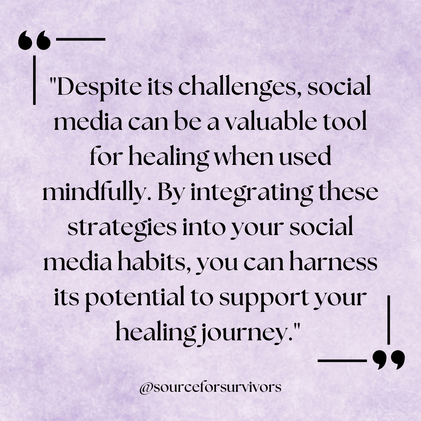
Overall, while social media may have its pitfalls, it can also be a valuable tool for healing when used mindfully. By integrating these strategies into your social media habits, you can harness its potential to support your healing journey while minimizing its negative impact. 

Picture
0 Comments

Your comment will be posted after it is approved.


Leave a Reply.

    Categories

    All
    Pathway For Survivors Model General Information
    Pathway For Survivors Model - General Information
    Survivor Commitment 1 Intentionality
    Survivor Commitment 1 - Intentionality
    Survivor Commitment 2 Safety
    Survivor Commitment 2 - Safety
    Survivor Commitment 3: Long Range Perspective
    Survivor Commitment 3: Long-Range Perspective
    Survivor Commitment 4: Steps Forward
    Survivor Commitment 5: Reflecting
    Survivor Commitment 6: Giving Back

    Archives

    April 2025
    March 2025
    February 2025
    January 2025
    December 2024
    November 2024
    October 2024
    September 2024
    August 2024
    July 2024
    June 2024
    May 2024
    April 2024
    March 2024
    February 2024
    January 2024
    December 2023
    November 2023

    RSS Feed

Picture
© The Source for Survivors. Unauthorized use and/or duplication of any material found at this web-site and blog without express and written permission from this site’s owner is strictly prohibited. Please note that The Source for Survivors is not a resource for providing personalized advice for any individual or organization, either through this website or any associated communication challenges that include but are not limited to social media, emails, or direct messages. The Source for Survivors also is not a crisis response resource. Please visit our Other Resource page for additional information, including 24/7 support resources related to domestic violence and mental health.
  • Home
  • About the Pathways Model
  • Find Your Pathway
    • Pathway for Survivors >
      • Blog - Pathway for Survivors
      • The Pathway for Survivors Mini-Journal
    • Pathway for Community Supports >
      • Blog - Pathway for Community Supports
  • Financial Abuse Recovery Book
  • Other Resources
  • About Christine Murray
  • Contact Form
  • Sign Up for Our E-Newsletter